For engineers or maintenance personnel frequently involved in the selection of valves and fittings, confusion among different thread standards often leads to leakage, thread damage, and even safety accidents.
BSP (British Standard Pipe) threads, as one of the most widely used pipe thread standards globally, dominate particularly in the UK, Europe, Asia, and many international projects.
This article will delve into the technical details of BSP threads, explore the typical characteristics of bsp pipe fittings, and systematically compare the difference between bspt and npt as well as the fundamental difference between npt and bspt threads, helping you make accurate judgments in practical engineering.
-
What are BSP threads? – Standard system and parameter definitions
BSP threads are the collective term for British Standard Pipe threads. Their technical specifications are mainly covered by two international standards: ISO 7-1 (taper threads for sealing) and ISO 228-1 (parallel threads for non-sealing). Based on geometry, BSP threads are divided into two subtypes:
BSPP (British Standard Pipe Parallel)
-
Thread angle: 55°
-
Crest and root: Radiused (rounded crest and root profile)
-
Thread geometry: Parallel, no taper
-
Sealing method: Sealing achieved by end-face gaskets or O-rings (non-thread sealing)
-
Typical applications: Hydraulic systems, instrument connections, low-pressure pneumatic lines
-
Identification example: G 1/2 indicates a nominal size 1/2 inch BSPP parallel thread
BSPT (British Standard Pipe Taper)
-
Thread angle: 55°
-
Crest and root: Radiused
-
Thread geometry: Taper ratio 1:16 (diameter changes by 1 mm for every 16 mm along the axis)
-
Sealing method: Interference fit of threads creates metal-to-metal contact sealing
-
Typical applications: Medium to high-pressure fluid systems, steam lines, fuel lines
-
Identification example: R 1/2 (external taper thread) and Rc 1/2 (internal taper thread)
In engineering, “BSP threads” usually require distinction based on whether taper is present, while NPT threads belong to a completely different system.
-
Core differences between BSPT and NPT: from thread angle to sealing mechanism
Engineers most often confuse BSPT and NPT because both use tapered geometry (taper ratio 1:16) and rely on thread interference to create self-sealing. However, they have essential differences in key parameters:
Parameter BSPT (ISO 7-1) NPT (ANSI/ASME B1.20.1)
Thread angle 55° 60°
Taper ratio 1:16 1:16
Thread profile Radiused crest + radiused root Flat crest (truncated approx. 0.1×pitch) + flat root
Threads per inch (1/2″) 14 TPI 14 TPI
Pitch diameter tolerance at reference plane Wider (ISO 7-1 Class A/B) Narrower (ANSI standard)
Sealing reliability Requires sealant/PTFE tape Usually also requires sealant, but theoretical interference is greater
In-depth technical analysis:
Although both BSPT and NPT have 14 threads per inch for the 1/2 inch size, the 5° difference in thread angle (55° vs. 60°) results in a 5° flank angle deviation. According to contact analysis in ISO/TR 10495, when a BSPT external thread is forcibly mated with an NPT internal thread, the effective contact area is only 35%–42% of the design value. Leakage paths will develop along the helix at pressures exceeding 5 bar.
In contrast, a proper BSPT-BSPT joint maintains initial sealing under 100 bar hydrostatic pressure (based on burst test data from an international pipe laboratory).
Furthermore, although both standards nominally specify a 1:16 taper, their tolerance bands differ. NPT requires taper variation not exceeding 0.0025 mm/mm per inch of length, while BSPT allows a deviation of ±0.003 mm/mm. For long thread engagements (e.g., over 4 full threads), the cumulative taper deviation can reach 0.02 mm, which is sufficient to disrupt the pressure distribution on the sealing surface.
-
Why cannot they be used interchangeably? – Warnings at three engineering levels
3.1 Thread angle mismatch leads to stress concentration
The 5° difference results in only line contact at the pitch diameter. Under tightening torque, the contact points undergo extreme plastic deformation, which not only fails to form a continuous sealing band but also accelerates thread wear. According to fatigue tests in ASME PCC-2, the probability of seal failure after 500 pressure cycles when mixing threads exceeds 80%.
3.2 Cumulative pitch error changes effective thread engagement length
Although the TPI is the same for a given nominal size, the definition of the reference plane (gaging point) differs significantly between BSPT and NPT. For example, the effective thread length of 1-inch BSPT is 16.5 mm, while that of 1-inch NPT is 17.8 mm. When an NPT external thread is screwed into a BSPT internal thread, an axial gap of 1.3 mm occurs, preventing the minor diameter of the external thread from contacting the major diameter of the internal thread to achieve the theoretical sealing interference.
3.3 Sealing medium compatibility risk
The radiused thread root of BSPT allows more sealant (e.g., PTFE tape) to remain in the clearance, while the flat root of NPT tends to extrude the sealant. Under high temperature (>150°C) or high pressure (>200 bar) conditions, mixed connections can suddenly leak due to different rates of sealant loss. Statistics from an oil refinery show that 23% of on-site instrument connector leakage incidents are directly related to mixing BSPT and NPT.
-
How to accurately identify BSP threads vs. NPT threads?
The following methods can be used for rapid on-site identification (without precision instruments):
-
Visual inspection of thread profile: Use a 10x magnifying glass. BSP threads (both BSPP and BSPT) have distinctly rounded crests, reflecting light softly; NPT threads have flat crests (small flats), reflecting light as straight lines.
-
Thread angle gauge comparison: Purchase 55° and 60° thread profile gauges (thread files). Place the gauge against the thread flank; full contact indicates the corresponding standard.
-
Reference outside diameter measurement: For 1/2-inch threads, the reference major diameter of BSPT is 20.955 mm, while NPT is 21.224 mm. However, batch variations exist, so use only as an auxiliary method.
-
Thread marking reading: Fittings or valves are usually marked: “G” or “R” denotes BSP series; “NPT” denotes American taper pipe thread. Note: “NPTF” is dryseal thread and also should not be mixed with BSPT.
-
Engineering selection recommendations and best practices
In global sourcing and mixed-installation projects, strictly follow these principles:
-
Specify standards clearly at the design stage: If project drawings reference ISO 7-1 or BS 21, all threaded fittings and valves must be BSP series; if referencing ASME B1.20.1, select NPT. Avoid mixing standards within the same pressure circuit.
-
BSPT joint sealing aid: Use 0.1 mm thick PTFE tape, wrap 2–3 turns in the direction of thread tightening. For BSPP parallel threads, always use an O-ring or bonded seal (e.g., ED seal) matched to the pressure rating.
-
Use adapter fittings when necessary: If a field connection between BSPT and NPT is unavoidable, purchase dedicated transition adapters – e.g., BSPT internal thread on one end, NPT external thread on the other – and require the manufacturer to provide a pressure test certificate (at least 1.5 times the system’s maximum pressure).
-
Critical system testing: In steam boilers, high-pressure hydraulic systems, or flammable media lines, perform pneumatic leak testing (immersion method or helium mass spectrometry) after assembly. Leak rate shall not exceed 1×10⁻³ mbar·L/s.
-
Professional capabilities of AIFN Fittings
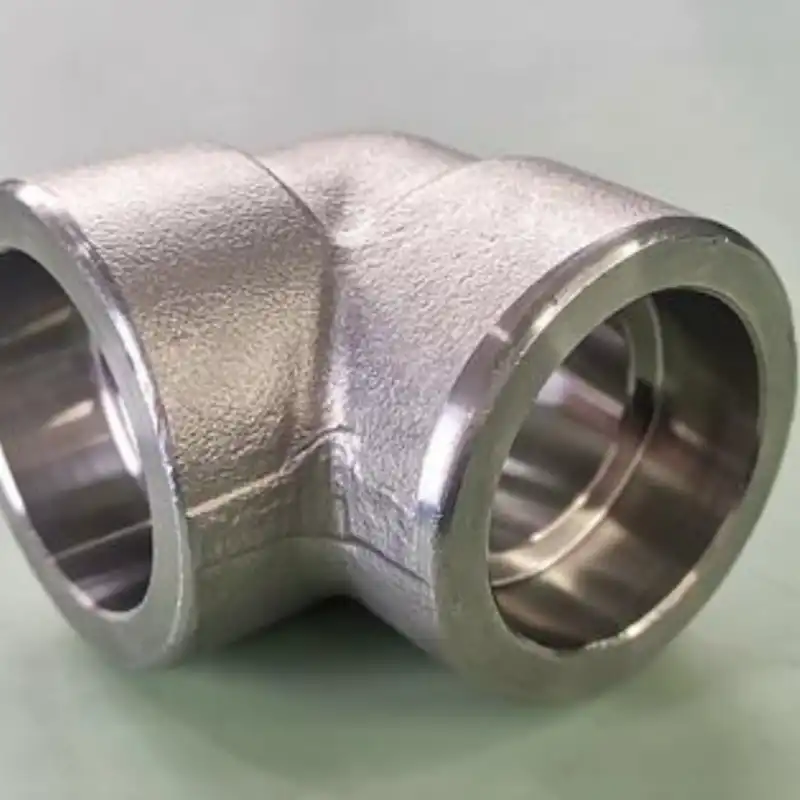
As a supplier specialized in pipe fitting components, AIFN strictly manufactures threaded products (including elbows, tees, unions, plugs, etc.) in accordance with ISO 7-1, ISO 228-1, and ASME B1.20.1. Every batch of BSP threaded fittings undergoes GO/NO-GO thread gauge full inspection, and random samples are subject to 100 bar hydrostatic seal testing.
Our technical team can provide you with thread selection matrices and compatibility calculation sheets to ensure your projects are free from mixing risks.