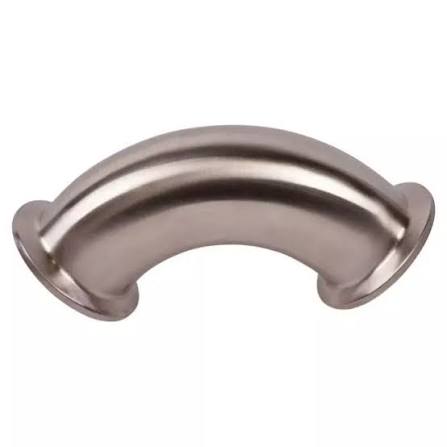
18-8 Stainless Steel vs. 304 Stainless Steel: Correct Material Selection for Pipe Elbows
In the design or maintenance of piping systems, two types of designations are often encountered: one is “18%-8% stainless steel” and the other is “304 stainless steel.” Many engineers and procurement personnel may wonder – are they the same material? If not, what differences do they have when used in fittings such as elbows and tees?
Chemical composition: 18%-8% is a description, 304 is a standard
✔️ “18-8” is a common term, representing approximately 18% chromium (Cr) and 8% nickel (Ni). This composition gives stainless steel its basic oxidation and corrosion resistance. 304 stainless steel, on the other hand, is a grade strictly defined by the American standard ASTM A240, with a chromium content ranging from 18.0%–20.0% and nickel from 8.0%–10.5%. In addition, 304 has clear limits on carbon (≤0.08%), manganese (≤2.0%), silicon (≤1.0%), and other elements.
✔️ The key difference is: all 304 stainless steel can be called 18-8, but the reverse is not true. Because the “18-8” group also includes grades such as 302, 301, and even some substandard low-cost materials, whose nickel content may be just at 8%, while 304 requires at least 8.0%, and in actual production is often above 8.2% to ensure stable performance.
Performance parameters: actual differences in corrosion resistance and strength
✔️ For pipe elbow fittings, the most critical concerns are resistance to intergranular corrosion and pitting resistance.
✔️ Due to more precise composition control, 304 stainless steel maintains better corrosion resistance after welding. For example, in the ASTM A262 Practice E test, the corrosion rate of 304 is typically below 0.05 mm/year, while some low-nickel 18-8 materials may reach 0.1–0.2 mm/year.
✔️ At room temperature, the yield strength of 304 is approximately 205 MPa, with tensile strength ≥515 MPa; whereas some non-standard 18-8 materials may be as low as 170 MPa. This means that in high-pressure pipe elbows, 304 provides a higher safety margin.
Practical application: how to select materials for pipe fittings
✔️ If your elbows are to be used in drinking water pipelines, food processing equipment, or outdoor supports, be sure to choose products marked “304” or “SUS304.” Such fittings can have a service life of more than 20 years in humid environments and meet FDA and NSF/ANSI 61 standards.
✔️ If they are only for non-load-bearing decorative pipe fittings in dry indoor environments, and the procurement contract clearly specifies “18-8 stainless steel conforming to ASTM 304 chemical composition,” then costs can be reduced by about 5%–10%. But note: to avoid supplier confusion, it is recommended to directly specify “304 stainless steel elbows.”
Summary: a reliable basis for judgment
-
Check the standard: “18-8” stamped on a fitting does not equal 304 unless accompanied by “ASTM A240 304”.
-
Perform tests: A simple magnetic test can be used – 304 becomes slightly magnetic after cold working, while inferior 18-8 may be more magnetic due to insufficient annealing.
-
Choose a trusted supplier: For core pressure-bearing fittings in piping systems such as elbows, flanges, reducers, always insist on using certified 304 stainless steel material – that is the safest approach.
📝At AIFN, every pipe elbow, tee, and cap we produce is strictly in accordance with the chemical composition and mechanical performance standards of 304 stainless steel, and we provide traceable material test reports. When your system needs to cope with corrosive media or temperature fluctuations, the correct material choice determines the safe life of the entire pipeline – starting from a small 45° elbow.