How to Select Stainless Steel Welding Elbows? A Technical Guide from an Experienced Pipe Fittings Supplier
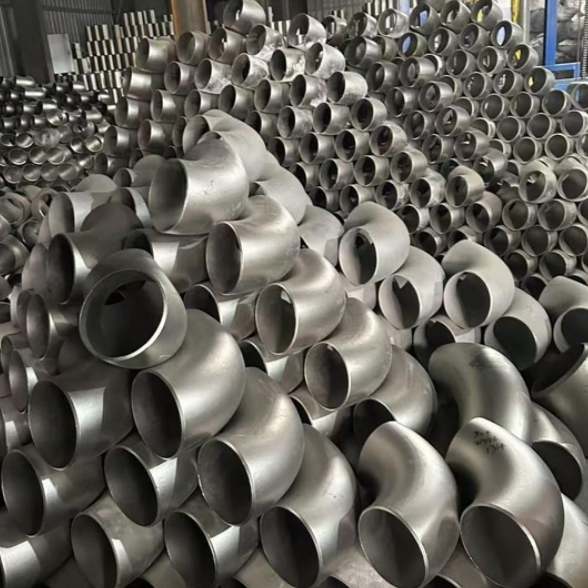
✔️In industrial piping systems, elbows are the most common components used to change the direction of fluid flow. For applications involving corrosive fluids, high-temperature steam, or clean media, stainless steel is almost the only choice.
✔️As a stainless steel pipe fittings supplier with over 8 years of export experience, we receive inquiries every day regarding the qualifications of stainless steel fittings supplier and product details.
✔️Among these, stainless weld elbows receive the highest number of inquiries, yet many users have blind spots regarding technical parameters, manufacturing standards, and how to evaluate supplier capabilities. This article provides a data-driven professional guide from four dimensions: material, dimensions, manufacturing process, and inspection standards.
1. Material Grades and Application Scenarios: Trade-offs Between 304, 316L, and Duplex Stainless Steel
Not all “stainless steel” can meet service conditions. According to ASME B16.9, common material grades for welding elbows and their key parameters are as follows:
| Grade | Key Chemical Composition Limits | Example Service Media | Pitting Resistance Equivalent Number (PREN) |
|---|---|---|---|
| 304/304L | Cr 18.0-20.0%, Ni 8.0-10.5% | Drinking water, low-pressure steam, non-oxidizing acids | ~18 |
| 316/316L | Cr 16.0-18.0%, Ni 10.0-14.0%, Mo 2.0-3.0% | Seawater, chloride environments (≤200ppm), organic acids | ~26 |
| 2205 Duplex | Cr 22.0-23.0%, Ni 4.5-6.5%, Mo 3.0-3.5%, N 0.14-0.20% | High chloride, oil & gas containing H₂S | ≥35 |
In actual selection, the wall thickness of stainless weld elbows must be calculated based on design pressure and temperature. For example, in a saturated steam pipeline of DN100 (4 inches) with design pressure 1.6MPa and temperature 150°C, if 316L is selected, the minimum wall thickness should not be less than Sch40 (4.55mm). Ignoring wall thickness grade and relying only on “experience” is a primary cause of premature weld failure.
2. Dimensional Tolerances and Geometric Accuracy: ASME B16.9 vs EN 10253-2
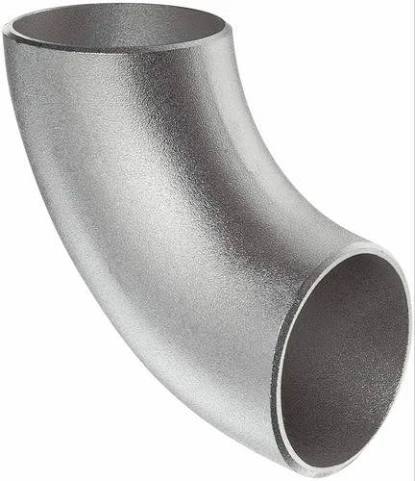
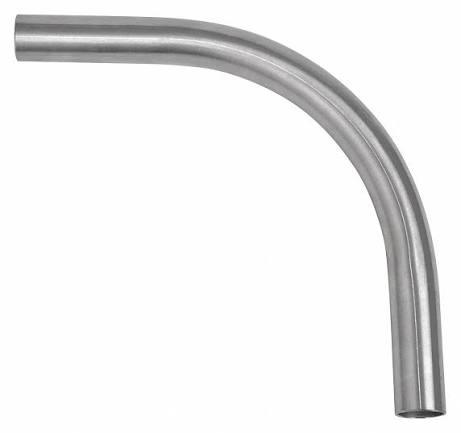
As a professional stainless steel fittings supplier, the standard we implement for elbows directly affects pipe alignment accuracy and stress distribution. Taking 90° long-radius welding elbows (LR) as an example, the dimensional differences between ASME B16.9 and European standard EN 10253-2 are noteworthy:
-
Center-to-end dimension: For a DN200 (8-inch) LR elbow, ASME B16.9 specifies 305mm (tolerance ±2mm); EN 10253-2 Series B specifies 304mm (tolerance ±1.5mm). Though small, the difference can cause cumulative errors in pre-fabricated high-precision modules.
-
Ovality: Standards require that the ovality at the elbow end not exceed 60% of the outside diameter tolerance. For example, for an elbow with OD 219.1mm (Sch40), the maximum ovality should be controlled within 0.6mm. We use a CMM to perform batch sampling on each lot of stainless weld elbows; measured ovality is typically less than 0.3mm, more than double the standard requirement.
Furthermore, wall thickness thinning ratio is a key indicator of manufacturing quality. Hot push-formed elbows inevitably experience wall thinning on the extrados (outer curved side), but ASTM A403 allows thinning not exceeding 12.5% of the nominal wall thickness. ♂️By precisely controlling the pushing temperature (1050°C~1150°C) and pushing speed, we can stabilize the thinning ratio between 8% and 10%, far superior to cheap products made by cold press-welding processes (which often have thinning ratios exceeding 15% and wrinkles on the intrados).
3. Manufacturing Process: Seamless vs. Welded, and Post-Weld Heat Treatment
The term “welding” in stainless steel welding elbows often causes confusion: it can refer either to the connection method of the fitting itself (butt-weld, BW) or to the forming process of the elbow (using a plate that is welded into a billet and then pushed).
True seamless stainless weld elbows (i.e., pushed from seamless steel pipe) are suitable for high pressure or intergranular corrosion-sensitive applications (such as urea plants). For large diameters (DN400 and above) or thin walls (Sch10S), elbows formed by rolling steel plate, welding, and then pushing are lower in cost and still offer reliable material density.
The key quality control point is Post-Weld Heat Treatment (PWHT) . According to ASME B31.3, for welded elbows made of 316L, if the wall thickness exceeds 19mm (3/4 inch), solution annealing is required: heat to 1040°C~1120°C, hold, then rapidly water cool. ♂️This step eliminates chromium carbide precipitation in the weld heat-affected zone and restores resistance to intergranular corrosion. Our factory is equipped with a computer-controlled solution annealing furnace, with temperature uniformity controlled within ±5°C, and each batch of products comes with a heat treatment curve record.
4. Non-Destructive Testing and Traceability: Quality Assurance from a Supplier’s Perspective
A responsible stainless steel fittings supplier does not rely solely on visual inspection. Before shipment, all stainless weld elbows should pass at least one of the following inspections (depending on standard requirements):
-
Radiographic Testing (RT) : According to ASME B16.9 Appendix I, for fittings in “severe service” categories, the RT sampling rate should be no less than 10%. We perform 100% RT on the weld seam (for welded-formed elbows), and retain radiographs for 15 years.
-
Penetrant Testing (PT) : Used for surface-opening defects (cracks, porosity). Sensitivity level C (defects with width of 0.5μm detectable).
-
Hydrostatic Test : Test pressure is 1.5 times the design pressure, held for at least 30 seconds. We actually perform 2.0 times pressure held for 2 minutes to ensure zero leakage.
Additionally, each elbow is laser-marked with a heat number (Heat No.), which allows traceability to the material certificate (MTC, compliant with EN 10204 3.1), heat treatment reports, and final inspection records. This full traceability is an important hallmark distinguishing a legitimate stainless steel fittings supplier from a mere trading company.
5. Application Examples: Offshore Platform and Food-Grade Piping
Example 1: Offshore oil production platform (North Sea environment, chloride concentration ~19,000ppm)
The customer required DN150 Sch80S 316L stainless steel welding elbows with a minimum extrados wall thickness not less than 6.0mm. ♂️By calculating the wall thinning ratio (design thinning 10%), we selected a mother pipe with nominal wall thickness of 6.8mm. The final product achieved an extrados measured wall thickness of 6.1mm, meeting sulfide stress corrosion (SSC) resistance requirements. It has been in safe operation for 4 years.
Example 2: Dairy production line (CIP cleaning, temperature 85°C, alternating acid and alkali)
The requirement was for an elbow internal surface roughness Ra ≤ 0.4μm, with no dead corners. We provided stainless weld elbows that were electropolished, achieving a measured roughness of Ra 0.2μm, and used long-radius elbows (R=1.5D) to reduce flow resistance, preventing bacterial biofilm formation.
Conclusion: How to Efficiently Screen Reliable Stainless Steel Pipe Fittings Suppliers
When you are looking for a stainless steel fittings supplier, be sure to request the following three documents:
-
Type test report (proving product compliance with ASME or EN standards)
-
Quality management system certificate (ISO 9001:2015, preferably with PED or CRN certification)
-
Third-party inspection reports from past orders (e.g., SGS, BV)
📝For the specific procurement of stainless weld elbows, it is recommended to specify the following parameters: nominal size (DN/NPS), wall thickness schedule (Sch), angle (45°/90°/180°), radius (short radius SR or long radius LR), material grade, applicable standard, and required inspection items. ♂️A professional supplier will proactively provide wall thinning ratio estimates and welding procedure qualification records (WPQR), rather than just a simple quote.