In industrial piping systems, the need to connect different thread standards is very common. British Standard BSPP parallel threads and American Standard NPT taper threads cannot be directly screwed together and require dedicated adapters.
➡️This article provides a technical deep dive into stainless steel BSPP to NPT adapters, covering thread geometry, sealing mechanisms, material properties, and practical selection.
I. Core Thread Differences: 55° Parallel vs. 60° Taper
✔️BSPP (ISO 228-1) uses a 55° thread angle, and the threads themselves do not create an interference seal; sealing relies on gaskets or O-rings inside the fitting (e.g., ED seals or metal face contact). NPT (ANSI/ASME B1.20.1), in contrast, uses 60° tapered threads with an inch-based pitch, achieving a metal-to-metal seal through interference fit on the thread flanks.
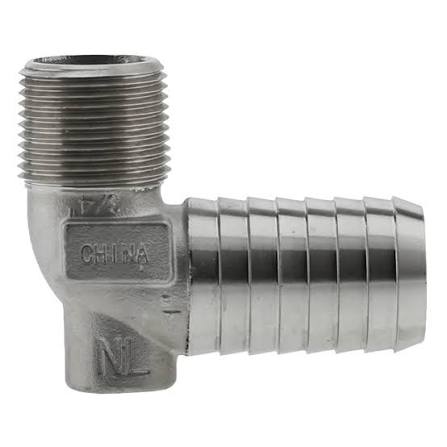
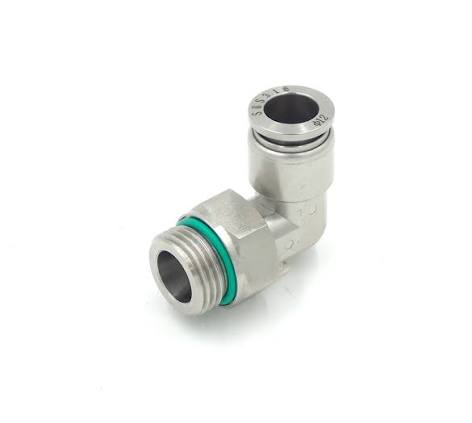
✔️When a proper BSPP-to-NPT adapter is introduced, one end is machined with BSPP parallel internal threads (G thread), while the other end features an NPT tapered external thread or internal thread.
✔️For example, in the 1/2-inch size, BSPP has 14 threads per inch, and NPT also has 14 threads per inch, but differences in thread angle and taper (NPT taper 1:16) make them non-interchangeable.
II. Engineering Advantages of Stainless Steel Material
✔️Choosing 304 or 316 stainless steel for these thread adapters significantly enhances corrosion resistance and mechanical strength. Taking 316 stainless steel as an example, its tensile strength is ≥515 MPa, yield strength ≥205 MPa, and its pitting resistance equivalent number (PREN) reaches above 25 in simulated seawater and acidic environments.
✔️For demanding applications such as chemical plants, offshore platforms, or sanitary food-grade piping, stainless steel BSPP to NPT adapter fittings maintain structural stability within a temperature range of -196°C to +450°C (note: actual stainless steel upper limit is about 800°C, but sealing elements restrict usage). Additionally, the material hardness (HB≤150) ensures that threads are not easily worn during repeated assembly and disassembly.
III. Sealing Performance and Installation Parameters
✔️Proper selection of sealing method is critical when using such adapters. The BSPP end typically uses a flat washer or O-ring groove, with tightening torque per recommended values (e.g., G1/2 torque approx. 40–50 N·m).
✔️The NPT end requires PTFE thread seal tape or thread sealant to achieve sealing through the wedge effect of the tapered thread. In terms of pressure rating, 316 stainless steel BSPP thread to NPT thread adapters can handle working pressures up to 3000 psi (approx. 20.7 MPa) at room temperature, with burst pressure exceeding 9000 psi. All AIFN-supplied fittings undergo 100% air tightness testing (1.5 times working pressure, held for 60 seconds with no leakage).
IV. Selection and Industry Practice
✔️Common nominal sizes in actual projects range from 1/8 inch to 4 inches. A special note: some low-quality cast adapters have stress concentrations at the tapered thread transition; bar stock machined or precision forged components are recommended.
✔️For high-vibration environments (e.g., hydraulic power units), extended BSPP to NPT thread adapters with lock nuts are recommended. For corrosive fluids, duplex stainless steel or increased wall thickness designs can be used.
V. Summary and Recommendations
✔️When selecting reliable BSPP to NPT adapter stainless steel products, one should verify thread markings (confirm G thread and NPT thread designations), material certificates (ASTM A276 standard), and third-party pressure test reports.
✔️With over 15 years of experience in pipe fitting manufacturing, AIFN provides high-precision adapters in full sizes and multiple materials to global customers, all products conforming to ISO 9001:2015 quality control system. Proper adapter selection not only eliminates leakage risks but also extends the service life of the entire piping system.