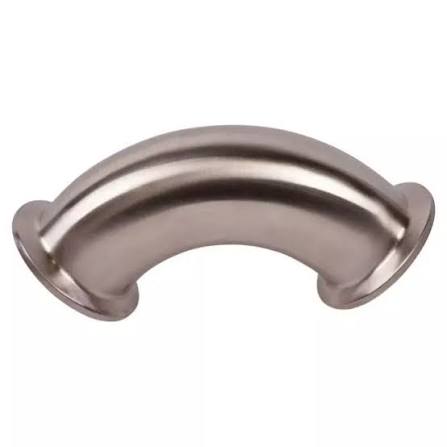
Are There Different Radii of Long Radius Elbows?
1. Standard Definition: What Is the Radius of a Long Radius Elbow?
For example, for an NPS 4 elbow, its bending radius = 4 × 1.5 = 6 inches (approximately 152.4mm). This parameter ensures the interchangeability of elbows with different angles during connection and enables more uniform distribution of centrifugal force during fluid diversion.
2. Most Common Angle Types: 90° & 45° Long Radius Elbows
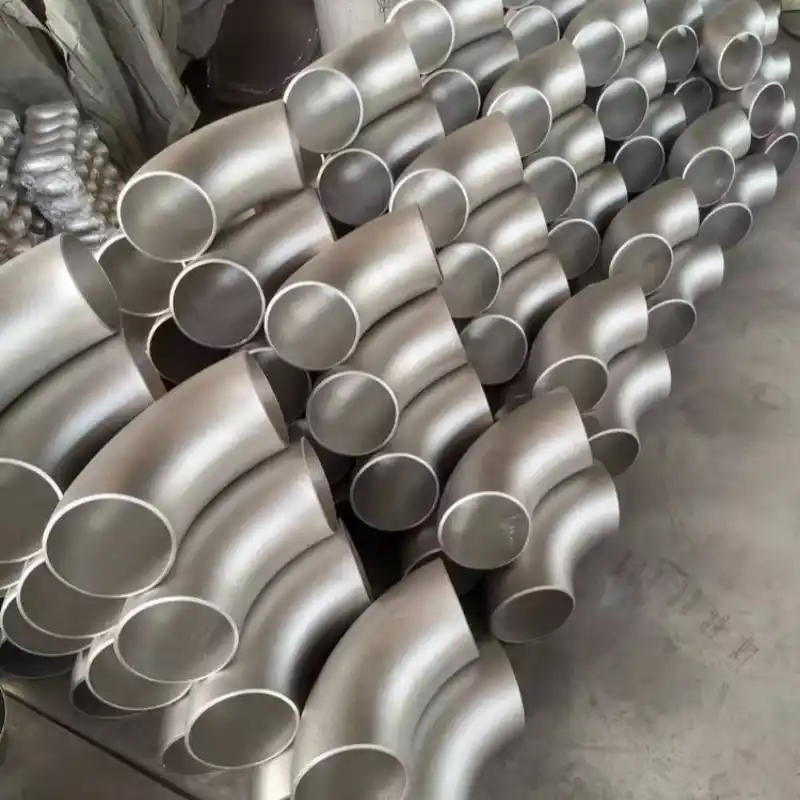
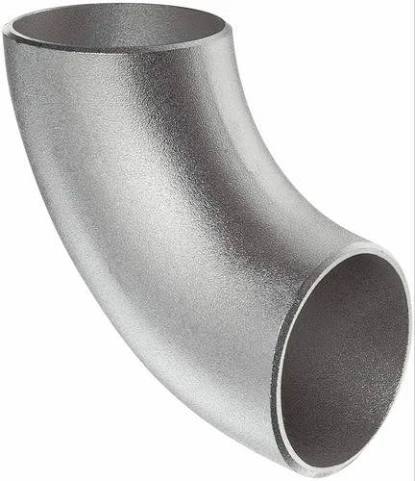
- The 90 degree long radius elbow is the most common and widely used specification in the pipe fitting market. It features a bending radius of 1.5D and a turning angle of 90°, applicable to right-angle turns of vertical or horizontal pipelines. Typical application scenarios include pump outlet pipelines, heat exchanger piping and main pipe rack lines.
In accordance with ASME B16.9, the center-to-end dimension of an NPS 6 90 degree long radius elbow is 9 inches (228.6mm), and the wall thickness schedule (Sch. 40/80, etc.) is selected according to the design pressure.
- The 45° long radius elbow provides a gentler direction change with the same bending radius of 1.5D. It is mainly used to reduce water hammer effect or bypass obstacles at a small pipeline angle.
Compared with the combination of two 45° elbows, a single 45° long radius elbow can reduce more than 50% of welding joints and minimize turbulence. For example, on a DN150 (6-inch) steam main pipeline, the local resistance coefficient (K value) of one 45° long radius elbow is about 0.2~0.25, while connecting two 90° elbows in series will increase the K value to over 0.5. Hence, under the same 1.5D radius, the 45° long radius elbow delivers better flow stability.
3. Beyond Standard: Extra Long Radius Elbow
A typical radius of an extra long radius elbow is 3D. For example, for an NPS 8 3D elbow, its radius = 8 × 3 = 24 inches (609.6mm), much larger than the 12 inches (304.8mm) of the standard 1.5D version.
Reasons for adopting oversize radius:
- Reduce erosion rate: When conveying gas-solid two-phase flow containing sand grains, pulverized coal or catalyst particles, the erosion rate of the elbow inner wall is inversely proportional to the square of the bending radius. Experimental data shows that under the flow velocity of 25m/s and particle concentration of 5%, the maximum erosion depth of a 1.5D elbow is 0.38mm/year, while that of an extra long radius elbow (3D) drops to 0.12mm/year, extending the service life by about 3 times.
- Minimize pressure loss: For high-viscosity fluids such as heavy oil and molten salt, local pressure drop accounts for a high proportion of total pipeline resistance. According to Crane TP-410 Flow of Fluids Through Valves, Fittings, and Pipe, the equivalent length (Le/D) of a 90° 3D elbow is about 12, compared with 16 for a 1.5D elbow. This means the extra long radius elbow can reduce additional local pressure drop by 25% compared with standard long radius elbows.
- Meet high-purity process requirements: In the semiconductor and biopharmaceutical industries, ultra-smooth diversion is required to avoid dead leg retention and turbulent shear. Adopting 5D or 10D extra long radius elbow can keep the Reynolds number at the edge of laminar flow or transitional flow and reduce particle generation.
4. Data Comparison: Specific Impact of Different Radii on Pipeline Performance
| Elbow Type | Bending Radius | Local Resistance Coefficient (K) | Equivalent Length (Le/D) | Pressure Drop per Elbow (kPa) |
|---|---|---|---|---|
| 1.5D (Standard Long Radius) | 152.4 mm | 0.21 | 14.2 | 0.67 |
| 3D (Extra Long Radius) | 304.8 mm | 0.14 | 9.5 | 0.45 |
| 5D (Extra Long Radius) | 508.0 mm | 0.10 | 6.8 | 0.32 |
5. Selection Guide: How to Choose Among Multiple Radii
- Prioritize standard 1.5D: For conventional transportation of water, oil and gas without severe abrasion or space constraints, the standard radius of long radius elbow (1.5D) is the most economical and reliable option. Within the scope of ASME B16.9, 90 degree long radius elbow and 45° long radius elbow are in sufficient stock with the shortest delivery lead time.
- Adopt 3D or above: If the medium contains solid particles, with flow velocity over 10 m/s (gas) or over 3 m/s (sand-containing liquid), it is highly recommended to select extra long radius elbow (at least 3D). For pipelines sensitive to vibration (such as reciprocating compressor outlets), 5D elbows can be used to reduce pulsation excitation force.
- Note the independence of angle and radius: Whether it is long radius elbow 90 degree or 45° long radius elbow, the radius value is only determined by the definition of long radius (1.5D) or the setting of extra long radius (3D+). The angle does not change the numerical value of bending radius, only the diversion amplitude.