Stainless Steel Tubing 90 Degree Elbow: In-depth Analysis on Engineering Selection and Performance of 1 Inch and 2 Inch Specifications
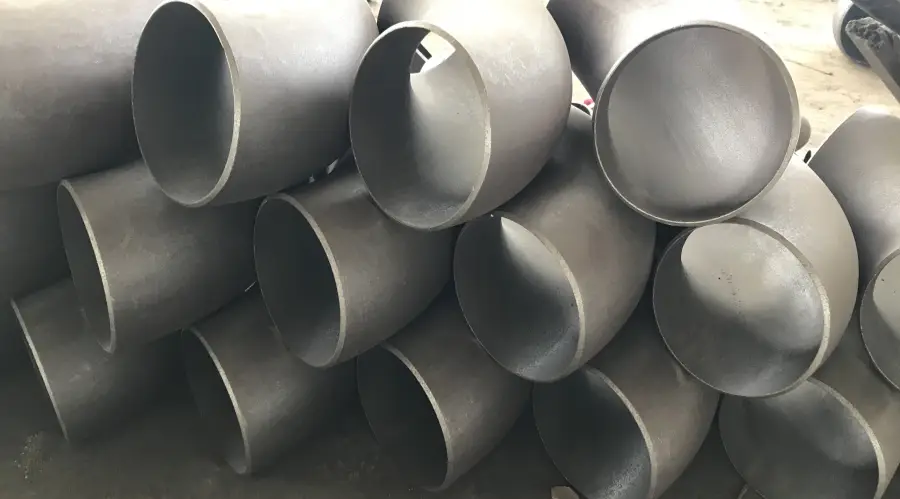
☑️In industrial fluid transmission and instrument pipeline systems, stainless steel tubing 90 degree elbow is a fundamental component for flow direction conversion. Its manufacturing precision and material properties directly affect the tightness, pressure resistance service life and safety factor of the entire pipeline loop.
☑️In accordance with ASME B16.9, ASTM A269/A213 standards, this article conducts a technical comparison between 1 inch stainless steel tubing 90 degree elbow and 2″ stainless steel tubing 90 degree elbow from the aspects of wall thickness tolerance, forming process, pressure rating and application scenarios, providing quantifiable selection references for engineers.
1. Core Dimensions and Wall Thickness Parameters
✅For fittings with an outer diameter of 1 inch (25.4 mm), typical wall thickness specifications include light wall (0.065 inch / 1.65 mm) and standard wall (0.083 inch / 2.11 mm). 2 inch (50.8 mm) fittings generally adopt a wall thickness of 0.120 inch (3.05 mm) to withstand higher torque.
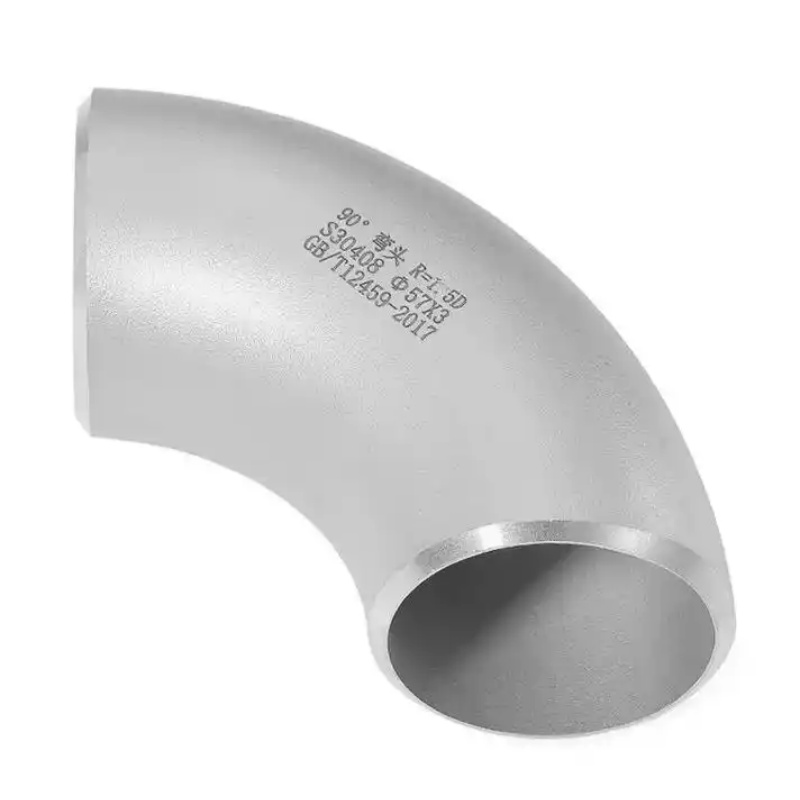
✅The bend radius (R) from the elbow center to the end face is a core parameter. For long radius (LR) elbows, R = 1.5 × nominal outer diameter. The center-to-face dimension of 1 inch LR elbow is 38.1 mm, and that of 2 inch elbow is 76.2 mm, which can reduce fluid turbulence loss by approximately 15%~20%. Short radius (SR) elbows feature R = 1.0 × outer diameter, which are mainly applied in confined spaces.
✅ASME B16.9 stipulates that the wall thickness reduction rate at elbow ends shall not exceed 12.5% of the nominal thickness. We adopt finite element simulation to optimize the push-bending process, keeping the wall thickness reduction rate within 8%.
2. Material Grades and Corrosion Resistance Data
✅The materials adopted are 304/304L or 316/316L austenitic stainless steel. Taking 316L as an example, its molybdenum content ranges from 2.5% to 3.0%. In chloride-containing environments (≤200 ppm, 60 ℃), its Pitting Resistance Equivalent Number (PREN) reaches 26, a 40% increase compared with 304.
✅Each batch of elbows undergoes intergranular corrosion test (ASTM A262 Method E) and eddy current testing. The surface roughness Ra is no more than 0.8 μm, meeting the high cleanliness requirements of pharmaceutical and semiconductor industries. Under the working condition of 10% sulfuric acid solution at 50 ℃, the uniform corrosion rate of 316L elbows is lower than 0.05 mm per year, while that of 304 elbows is 0.2 mm per year. This is a critical indicator for material selection in chemical medium service.
3. Pressure-Temperature Rating and Process Adaptability
✅Calculated by the mean diameter formula in compliance with ASME B31.3 standard: for 316L elbows with 1 inch outer diameter and 0.083 inch wall thickness, the Maximum Allowable Working Pressure (MAWP) is 1820 psi (approx. 12.5 MPa) at 150 ℃. For elbows of the same material with 2 inch outer diameter and 0.120 inch wall thickness, the MAWP drops to 1210 psi (8.3 MPa) due to increased hoop stress.
4. Typical Applications and Installation Notes
✅1 inch elbows are widely used in analytical instrument sampling pipelines, lubrication systems and cryogenic liquid nitrogen transmission. Its impact energy is no less than 60 J at the operating temperature of -196 ℃. 2 inch elbows are commonly applied in chemical batching loops, steam tracing main pipelines (saturated steam ≤200 psi) and food-grade CIP cleaning pipelines.
✅Installation precautions: Hardened ferrules shall be used for compression fitting connections. The recommended tightening torque is 45 N·m for 1 inch fittings and 90 N·m for 2 inch fittings. For butt welding connections, backside argon shielding is required to avoid oxidation and slag formation at the weld root.
📌AIFN Metal Technology provides material certificates, radiographic testing reports and hydrostatic test records for every batch of elbows. Custom long radius elbows and non-standard angle elbows with extra-small bend radius (R<1.0D) are available. For technical inquiries, refer to the supplementary data on stress corrosion cracking of elbows published in the September 2024 issue of the international piping journal Stainless Steel World.