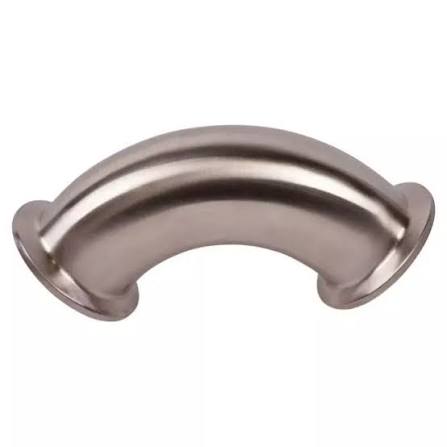
What Exactly Is the Radius Size of a Long Radius Elbow?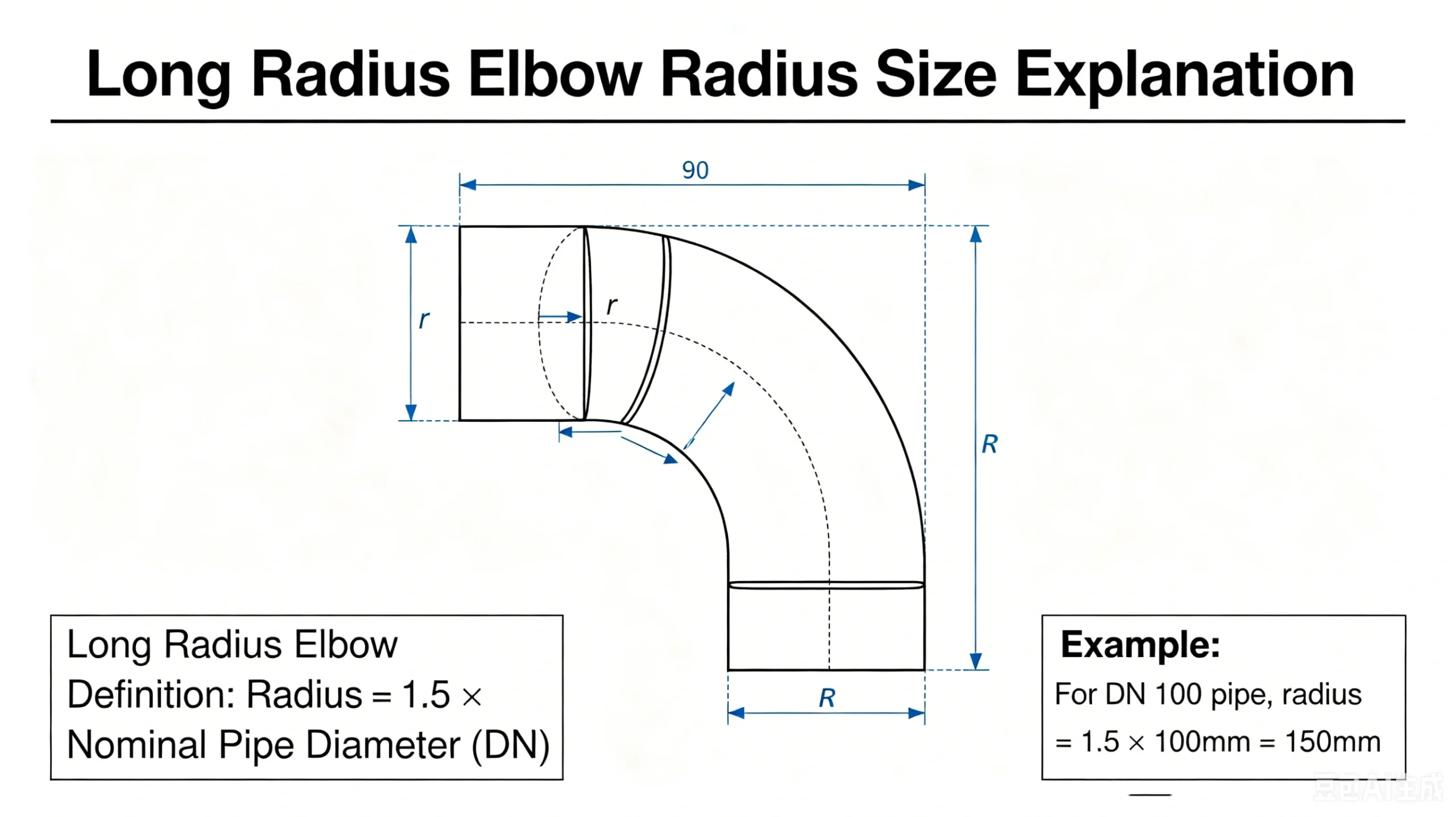
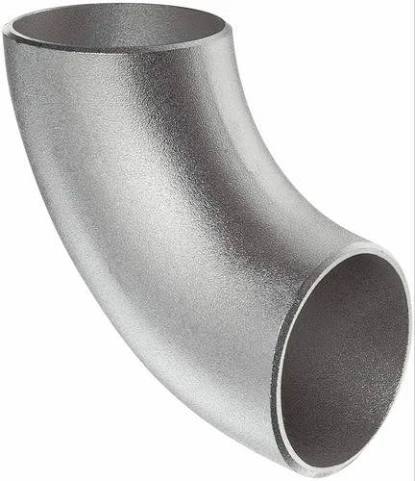
✅In piping systems, the “radius” of an elbow directly determines fluid resistance, erosion risk, and installation space. For a long radius elbow (LR elbow), the radius size has a clear industrial definition: the centerline radius (i.e., R) equals 1.5 times the nominal pipe size (NPS).
✅In other words, if you are using NPS 4-inch (DN100) pipe, the long radius elbow has R = 4 × 1.5 = 6 inches (152.4 mm). This ratio is codified by ASME B16.9, clearly distinguishing it from short radius elbows (R = 1.0 × NPS).
✅However, the “radius size” is not a single value—it involves the center-to-end dimension (A dimension), as well as the end-to-tangent point distance.
☑️Taking the most common 90° long radius elbow as an example, its center-to-end straight-line distance on both ends is 1.5 × NPS (i.e., the R value). For a 45° long radius elbow, that distance is 0.625 × NPS (approximately 0.625R).
☑️If you are consulting a long radius elbow dimensions chart, you will find that for NPS 6-inch (DN150) 90° LR elbow, the center-to-end dimension is 9 inches (228.6 mm), while the 45° version is 3.75 inches (95.2 mm). These basic data are the starting point for pipe stress analysis and support/hanger design.
Key detail: The “actual bending radius” of a long radius elbow is not the pipe inside diameter or outside diameter, but rather the projected distance from the welding or threaded connection point’s centerline to the elbow’s arc center.
✔️Regarding manufacturing tolerances, ASME B16.9 specifies: for NPS ≤ 10, the center-to-end dimension tolerance is ±1.6 mm; for NPS ≥ 12, the tolerance is ±3.2 mm. Wall thickness must meet minimum thickness requirements (typically following schedule series such as Sch 40, Sch 80), and the wall thickness at the elbow back (extrados) shall be no less than 87.5% of the straight-pipe wall thickness. These parameters directly affect the safety margin under high-pressure conditions.
✔️For engineering selection, in addition to the basic R value, one must also consider pipe fitting bend radius standards such as MSS SP‑43 (supplementary provisions for thin-wall stainless steel elbows) and EN 10253‑2 (differing requirements for European standards).
✔️For large diameters (NPS ≥ 14) or thick-wall pipes, the actual cutting length of a long radius elbow must also include the tangent length—typically a straight section of 25–50 mm reserved at each end for butt-welding.
✔️Additionally, ASME B16.9 elbow dimensions clearly specify outside diameter (OD) series: the A series (imperial) and B series (metric) have slight OD differences—for example, NPS 8 A-series OD is 219.1 mm, while B-series is 216.3 mm. This slightly affects the absolute radius value, but the ratio remains strictly 1.5 × NPS (calculated based on nominal diameter).
✔️From a fluid mechanics perspective, long radius elbows, due to their gentler curvature, have an equivalent resistance coefficient (K‑value) of about 0.18 (compared to 0.33 for short radius elbows), and the erosion rate is reduced by approximately 40%. This advantage is particularly prominent in high-temperature, high-pressure steam lines or chemical slurry piping.
✔️At the same time, during procurement, one should verify the material’s impact toughness (e.g., A234 WPB requiring impact energy ≥ 27 J at ‑29°C) and confirm the elbow’s ovality (the difference between maximum and minimum OD not exceeding 3% of the nominal outside diameter).
✔️Finally, in actual engineering, the “radius size” also involves non‑standard bend angles—for example, 60° or 22.5° long radius elbows. Their center-to-end distances need to be calculated using trigonometric functions, but the curvature radius R remains 1.5 × NPS and does not change with the angle.
📌With this ratio, combined with the specific project’s wall thickness schedule and end connection type (BW, SW, or threaded), you can accurately lock in all dimensional parameters. If you have a piping layout drawing at hand, it is advisable to prefer long radius elbows—they reduce pressure drop and extend the service life of the bend section. This is widely recognized as one of the best practices in the global refining and power generation industries.