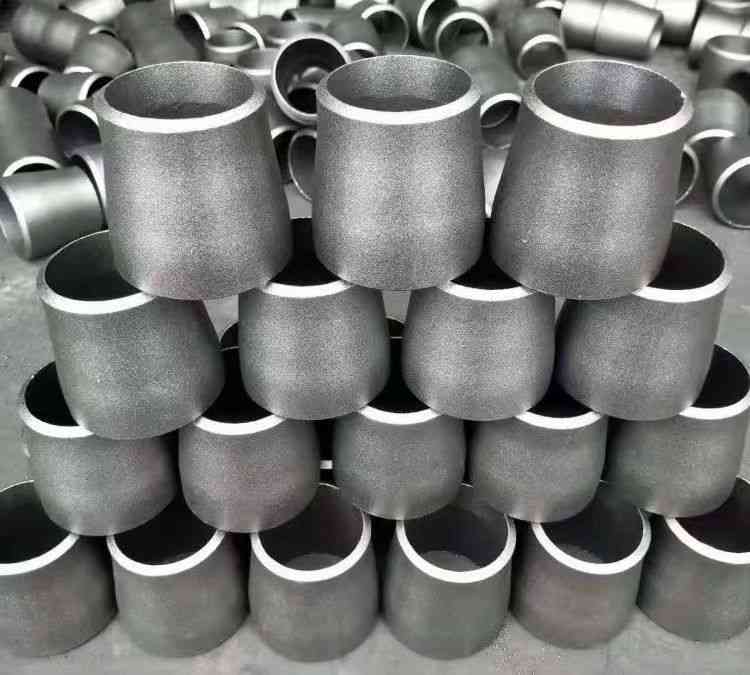
Eccentric Reducer Pipe Fitting | Prevents Sediment Buildup
Eccentric reducer pipe fitting for horizontal piping to avoid sediment. Choose eccentric swage reducer, weld reducer, or 6″ x 2″. Contact us for a quote!
Description
Materials & Manufacturing Standards
Material Options
Manufacturing Processes
Applicable Standards
Specification Parameters & Connection Types
Common Size Range
Nominal Diameter: 1/2″ × 1/4″ to 48″ × 36″
Typical Specification: 6″ x 2″ eccentric reducer (Outer Diameter: 168.3mm→60.3mm, Length: 152mm)
Eccentric Reducer Pipe Fitting Parameters
| Nominal Size (inch) | End Outer Diameter (mm) | Length L (mm) | Wall Thickness Schedule | End Connection Type |
|---|---|---|---|---|
| 6 x 2 | 168.3 × 60.3 | 152 | Sch 40 / STD | Butt Weld (BW) |
| 8 x 4 | 219.1 × 114.3 | 178 | Sch 40 / XS | Butt Weld / Socket Weld |
| 12 x 6 | 323.9 × 168.3 | 203 | Sch 20 / Sch 40 | Butt Weld (BW) |
| 4 x 2.5 | 114.3 × 73.0 | 127 | Sch 80 | Forged (swage) |
Eccentric Reduce Design
Application Scenarios of Eccentric Reducer Pipe Fitting
- Petrochemical Industry: Horizontal pipelines at pump inlets to avoid cavitation and turbulent impact
- Sewage Treatment: Prevent solid particles from settling and forming dead zones at diameter changing sections
- Power Plant Condensate Systems: Ensure continuous discharge of condensed steam water
- Food & Pharmaceutical Industry: Sanitary design with no residual dead corners
Buyer Common FAQ
Q1: What are the core differences between eccentric reducers and concentric reducers? How to make a proper selection?
A: A concentric reducer features aligned central axes at both ends, suitable for vertical pipes and risers. In contrast, the eccentric reducer pipe fitting maintains a horizontal pipe bottom and is exclusively designed for horizontal pipelines. The eccentric type is mandatory for horizontal pipelines conveying liquid and solid particles or requiring cavitation avoidance.
Q2: What key points should be noted during the welding installation of an eccentric weld reducer?
A: First, confirm the installation direction of the reducer, ensuring the Flat Bottom is placed at the pipeline base. Second, verify that the bevel angle and root face comply with the process piping code ASME B31.3. For specifications with a large reduction ratio such as the 6″ x 2″ eccentric reducer, GTAW backing welding combined with SMAW filling welding is recommended, and 100% Radiographic Testing (RT) shall be conducted to eliminate incomplete fusion defects inside the pipe.
More Products