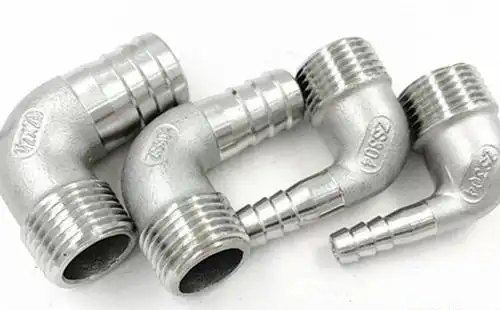
Stainless Steel Pipe Reducing Elbow for Compact Piping
Stainless steel pipe reducing elbow for changing pipe size and direction in one fitting. Compare large and small end sizes, schedule, radius, and weld ends.
Description
Stainless Steel Pipe Reducing Elbow for Compact Piping
stainless steel pipe reducing elbow can complete a 90-degree direction change and a change in pipe size at the same connection point. In a typical butt weld assembly, the integral configuration can eliminate a separate reducer and reduce one fitting-to-fitting weld. Before ordering, confirm Large End x Small End, installation orientation, center-to-end dimensions, and the Pipe Schedule at both ends; size combinations, bevels, and inspection documentation can be customized to project requirements, subject to technical review and order confirmation.
Large End, Small End, and Installation Orientation
The specification should be written as Large End x Small End, for example NPS 6 x NPS 4. The drawing should identify the connection direction of the large and small ends and verify the pipeline centerline, elevation, and interface position.
Center-to-End Dimensions and Pipe-Spool Fit-Up
The center-to-end dimension determines the turning point and the location of the next weld. Even when several small-end combinations with the same large end use the same dimension, the project standard and manufacturer drawing should govern to avoid a prefabricated pipe spool that cannot be fitted in place.
Wall Thickness and Butt Weld End Matching
The two ends may correspond to different NPS and Pipe Schedule values, so outside diameter, end-wall thickness, and bevel should be confirmed separately. Where the wall-thickness difference is substantial, end transition and welding preparation should follow the project WPS.
Product Specifications
| Parameter | Specification |
|---|---|
| Product Name | Stainless Steel Pipe Reducing Elbow |
| Product Type | 90 Degree Long Radius Butt Weld Reducing Elbow |
| Elbow Angle | 90° |
| Size Combination | NPS 2 x NPS 1 to NPS 24 x NPS 22, common preset |
| End Designation | Large End x Small End |
| Material | Stainless Steel 304, 304L, 316, 316L |
| Material Standard | ASTM A403 / A403M |
| Material Grade | WP304, WP304L, WP316, WP316L |
| Bend Radius | Long Radius |
| Pipe Schedule | Specified separately for Large End and Small End, subject to order confirmation |
| Connection Type | Butt Weld |
| Dimensional Standard | ASME B16.9 |
| End Preparation | Beveled Butt Weld Ends, subject to ASME B16.25 and project WPS |
| Manufacturing Type | Seamless or Welded, subject to size combination and order confirmation |
| Applicable Media | Water, Oil, Gas, Steam and Compatible Chemical Fluids |
| Applications | Equipment Nozzle Transitions, Compact Pipe Spools, Skid-Mounted Piping and Process Lines |
| Pressure Rating | Determined by Material Grade, Wall Thickness at Each End, Temperature and Applicable Piping Code |
| Inspection Items | Visual Inspection and Dimensional Inspection |
| Customization | Size combinations, Large End and Small End Pipe Schedule, end preparation and inspection documentation, subject to technical review and order confirmation |
Integral and Combined Configuration Comparison
| Comparison | Integral Reducing Elbow | Standard Elbow + Reducer |
|---|---|---|
| Fitting Configuration | One Combination Fitting | Two Separate Fittings |
| Typical Welds | Usually One Fewer Fitting-to-Fitting Weld | Usually One Additional Fitting-to-Fitting Weld |
| Layout Length | More Compact | Usually Requires More Layout Length |
| Field Adjustment | Combination and Center Dimensions Are More Fixed | Straight-Pipe Length and Position Are Easier to Adjust |
| Ordering Focus | Large and Small Ends, Orientation, and Wall Thickness at Both Ends | Select the Two Fittings Separately |
Applications and Industry Solutions
stainless steel pipe reducing elbow is suitable where the direction change and pipe-size change occur at the same point, including equipment nozzles, compact prefabricated pipe spools, skid-mounted modules, and retrofit connection points. It can shorten the combined layout but provides less field-adjustment allowance.
Key selection points include:
- Equipment nozzles: confirm the nozzle NPS, pipeline NPS, and large-end orientation.
- Prefabricated pipe spools: verify the center-to-end dimension and the location of the next weld.
- Different wall thicknesses: confirm the Pipe Schedule and bevel at both ends separately.
- Retrofit projects: verify available space, removal and installation path, and field dimensions.
Frequently Asked Questions (FAQ)
1. When should a reducing elbow be used instead of a standard elbow plus a separate reducer?
When the direction change and pipe-size change occur at the same point, space is limited, and the large- and small-end directions are already defined by drawings, an integral reducing elbow may be selected. A standard elbow plus a reducer requires more length and welds but provides greater field-adjustment flexibility.
2. Why must the Pipe Schedule for the large and small ends be confirmed separately?
The large and small ends may connect to different NPS and wall thicknesses, and their end-wall thickness and bevel conditions may also differ. Specifying the Pipe Schedule separately helps match the connecting piping, project WPS, and machining requirements at both ends of the stainless steel pipe reducing elbow.
More Products