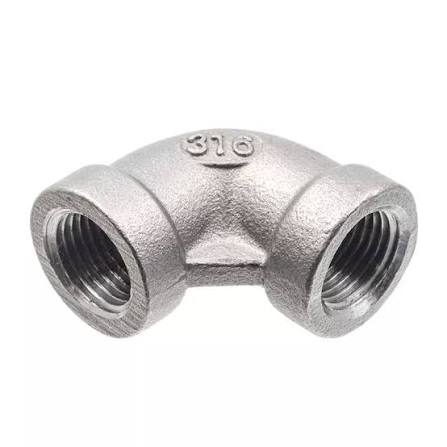
Stainless Steel Female Elbow with Dual FNPT Ends
Stainless steel female elbow with dual FNPT ends. Compare equal or reducing sizes, thread standard, Class, center dimensions, material, and sealant.
Description
stainless steel female elbow is used for 90° changes of direction between two male-threaded fittings or equipment ports. A common configuration is FNPT x FNPT.
female to female elbow and stainless steel 90° female threaded elbow
These terms usually describe a 90° elbow with two female-threaded ends. Each Female Thread Size should be stated separately in the inquiry, even when the two sizes are the same. Where the installed position is fixed, H, H1, center-to-end dimensions, and wrench clearance should also be checked.
stainless steel reducing female elbow
A reducing configuration should clearly identify the large and small end sizes rather than listing two numbers without their orientation. When the ends connect different equipment or pipe sections, flow-path transition, external interference, and the disassembly sequence should also be reviewed. A reducing female elbow cannot replace every layout function of a separate Reducer.
stainless steel short female elbow
Short Female Elbow indicates a compact center dimension, but short is not a unified dimensional class. The purchaser should obtain the manufacturer’s drawing and verify the center dimensions, wrench hex, effective thread length, and operating clearance around adjacent components so the fitting can be tightened after connection.
threaded elbow stainless steel
The thread system, material, and sealing method should be confirmed as one assembly. Tapered pipe threads such as NPT should use project-approved sealing material and installation procedures. Overtightening should not be used to compensate for dimensional or sealing problems. Class identifies a standard series; actual pressure still depends on material, temperature, threads, sealing, and the applicable code.
Four-Step Installation Check for a Stainless Steel Female Elbow
First, clean and inspect the internal thread form. Second, verify the thread standard and size at both ends. Third, apply the sealing material according to the project procedure and apply torque through the body wrench hex. Fourth, confirm outlet orientation, visible thread condition, and surrounding operating clearance. Any leakage or pressure testing after installation should follow the system specification.
Thread-End Protection and Receiving Identification
Threaded ends should use protective caps during transport and storage to prevent impact damage, rust particles, and packaging debris from entering the flow path. At receipt, in addition to using go/no-go gauges or project-specified gauges, inspect port alignment, internal burrs, wrench hex, and product marking. Equal, reducing, and different-Class fittings should be packaged separately to prevent site mixing based only on appearance.
stainless steel female elbow Specifications
| Parameter | Specification |
|---|---|
| Product Name | Stainless Steel Female Elbow |
| Product Type | 90 Degree Female Threaded Elbow |
| Connection Pattern | FNPT x FNPT, equal or reducing by order |
| Thread Standard | NPT per ASME B1.20.1 common preset; other systems by confirmation |
| Pressure Class | Class 2000, 3000 or 6000 for threaded forged fittings, by design |
| Material | F304, F304L, F316 or F316L, subject to applicable specification |
| Port Sizes | Both female thread sizes specified separately |
| Body Pattern | Equal, reducing or short-body configuration by drawing |
| Dimensions | Center-to-end dimensions, H/H1 and wrench hex confirmed by drawing |
| Thread Sealing | Sealant or tape selected by medium and approved installation procedure |
| Pressure / Temperature | Determined by Class, material, thread engagement, seal, temperature and piping code |
| Inspection Items | Visual, dimensional, thread-gauge, port-size, marking and material-document review |
| Customization Boundary | Angle, end sizes, Class, material, center dimensions, marking and documents, subject to technical review |
Frequently Asked Questions (FAQ)
1. Why does a 1/2 inch stainless steel female elbow still require confirmation of the thread standard?
1/2 inch states only the nominal size and does not identify NPT, NPTF, BSPP, BSPT, or another thread system. Different threads should not be considered compatible only because they look similar or can be turned together for several threads. The purchase order and mating male-threaded end must use the same confirmed standard.
2. Does deeper engagement of a female thread always produce a better seal?
Not necessarily. Engagement depth is affected by thread tolerances, sealing material, and the mating port. Overtightening may damage the thread or cause the elbow orientation to move out of position. The stainless steel female elbow should be verified using the specified installation and inspection procedure rather than by comparing hand-tight turns alone.
More Products