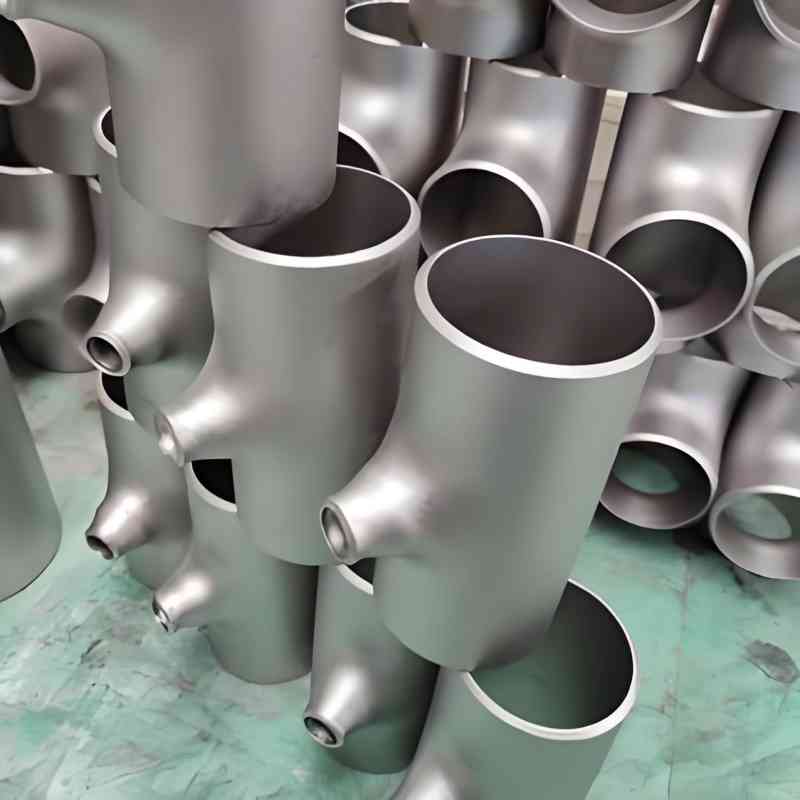
Stainless Steel Pipe Tee | High Pressure & Leak-Proof
High-quality stainless pipe tee for industrial piping. Excellent pressure rating, corrosion resistant. Threaded or welded ends. Request a quote now!
Description
Stainless Pipe Tee – Connection and Pressure Characteristics
Features and Quality Assurance of Stainless Pipe Tee
-
Corrosion Resistance
With chromium and nickel content ≥ 18%, it adapts to service environments including seawater, acidic media and high-temperature steam.
-
Precision Dimension Control
The outer diameter tolerance of pipe ends is ±0.5mm, and the wall thickness tolerance complies with ASTM standard within 12.5%.
-
Full Traceability
Material heat number, implementation standards and dimensional specifications are laser marked on each pipe fitting body to support full source traceability.
-
Diverse Reducing Options
In addition to equal tees, we also provide stainless reducing tee for seamless connection between main pipes and branch pipes of different sizes. For special working conditions requiring asymmetric branch pipes, stainless steel unequal tee can flexibly meet the diameter matching requirements of each pipeline direction.
Technical Parameter Table of Stainless Pipe Tee
| Parameter Item | Specifications & Options |
|---|---|
| Nominal Size | 1/2″ – 48″ (DN15 – DN1200) |
| Wall Thickness Schedule | Sch10, Sch20, Sch40, Sch80, Sch160, XXS |
| Pressure Class | Class 150 / 300 / 600 / 900 / 1500 / 2500 |
| Common Materials | SS304, SS304L, SS316, SS316L, SS321 |
| Implementation Standards | ASTM A403, ASME B16.9, MSS SP-43 |
| Connection Type | Butt Weld (BW), Socket Weld (SW), Thread (NPT/BSPT) |
Typical Application Scenarios of Stainless Pipe Tee
- Petrochemical Industry: High-temperature and high-pressure branch pipelines in catalytic cracking units.
- Natural Gas Distribution: Flow dividing and manifold systems inside metering skids.
- Shipbuilding Industry: Ballast water treatment pipelines and fuel oil transmission lines.
- Pharmaceutical & Bioengineering: Connection points for clean steam and purified water delivery.
- Nuclear Power Conventional Island: Stainless steel branch joints of circulating cooling water systems.
Common Purchasing FAQs
Q1: How to choose between welded end and threaded end of Stainless pipe tee? Which type features higher pressure resistance?
A: For working conditions with pressure exceeding Class 600 (about 10MPa) or temperature above 300℃, butt weld (BW) connection is highly recommended. Welded connection forms a full penetration structure with equal strength to the main pipe, ensuring zero leakage. Threaded ends (NPT/BSPT) are suitable for medium and low-pressure instrument pipelines or fire protection systems below Class 300, featuring simple installation with PTFE tape or sealant for auxiliary sealing. Socket weld (SW) connection is an ideal option for on-site non-fire working conditions, with pressure resistance performance between butt weld and threaded connection.
Q2: What dimensional tolerance standard is adopted for purchasing stainless reducing tee? Is third-party inspection acceptable?
A: We strictly implement the dimensional, wall thickness and roundness tolerance specifications for reducing tees specified in ASTM A403 and ASME B16.9. Custom diameter ratios between main pipes and branch pipes such as 2:1 and 1.5:1 are available. Material test certificates (EN 10204 3.1) are provided for all products by default. We accept on-site sampling and testing commissioned by third-party institutions including SGS, BV and TÜV. For bulk orders, 100% radiographic inspection reports and complete hydrostatic test records can be supplied.
More Products